
PentaBESS for business
Commercial and industrial battery storage
Peak shaving, demand charge management and outage cover for factories, telecom sites and commercial property, built on the 261 kWh PentaVault Citadel.
- Capacity per cabinet
- 261 kWh
- Continuous power
- 125 kW
- Cooling
- Liquid, IP54
- Scaling
- Parallel cabinets
The commercial case
Industrial storage earns its cost three different ways
For a household, a battery is mostly about avoided imports and keeping the lights on. On an industrial site the arithmetic is wider, because an industrial electricity bill has more than one component to attack.
The first is the unit rate. Discharging through peak tariff hours and recharging when rates fall reduces what the same consumption costs. The second is the maximum demand charge, which is set by your highest half hour rather than your total usage. The third is continuity, where a single lost shift can exceed a year of tariff savings.
A proposal that counts only the first of those three understates the case, and most do. We model all three against your actual load profile before quoting a cabinet count.
- Peak tariff arbitrage across the working day
- Maximum demand charge reduction, billed on your worst half hour
- Production continuity through unplanned outages
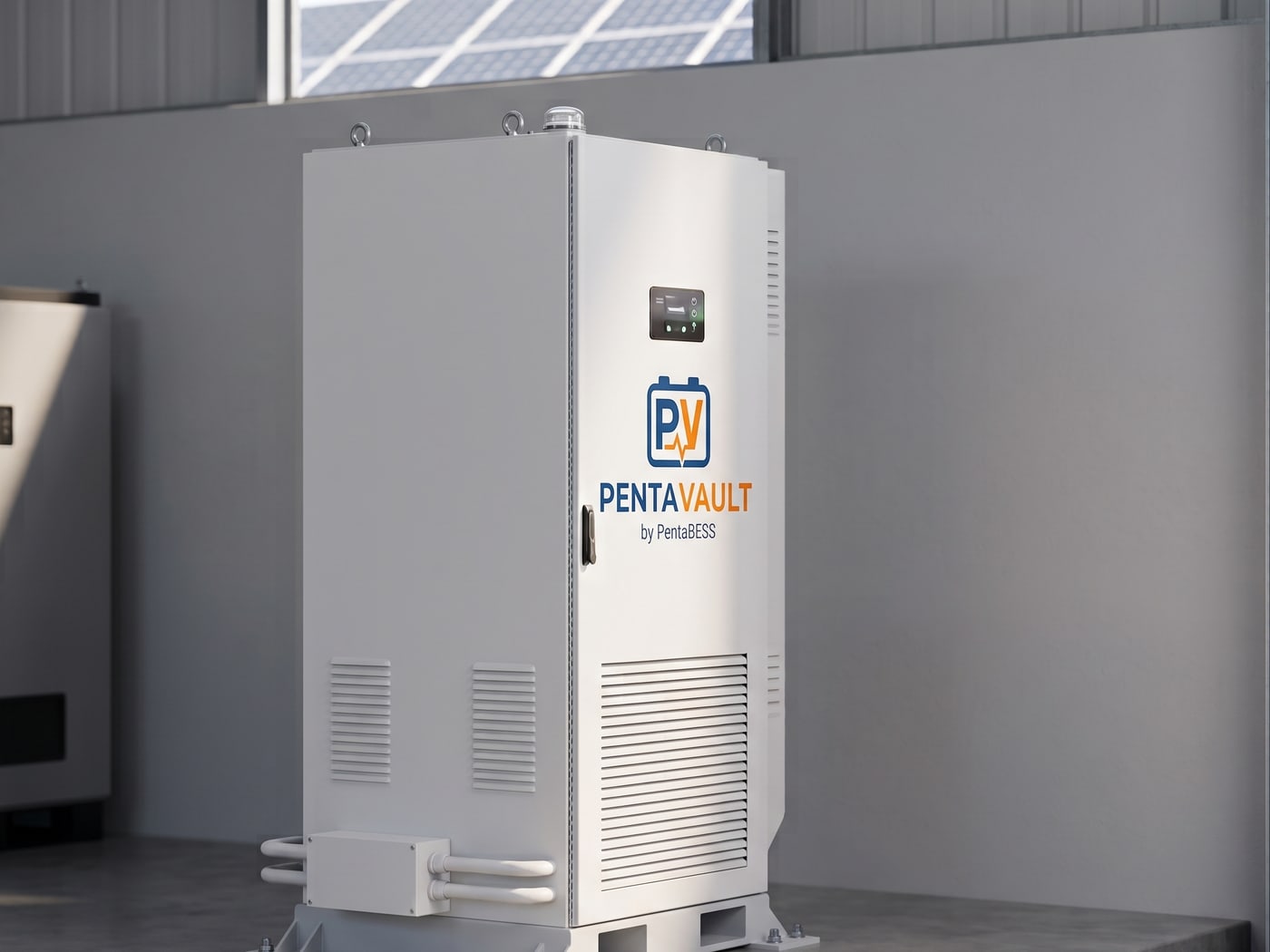
One cabinet, 261 kWh, 125 kW continuous
Liquid cooled and IP54 rated, so it holds its capacity through a Multan summer rather than derating when you need it most. Cabinets run in parallel as the site grows.
The Citadel at a glance
- Capacity per cabinet
- 261 kWh
- Continuous output
- 125 kW
- Protection rating
- IP54
- Operating range, Celsius
- -30 to 55
98 percent depth of discharge
137 kW peak
Outdoor and semi-outdoor viable
Liquid cooled with dehumidifier
Applications
Where we deploy industrial storage
Manufacturing and processing
Carry production through outages so a shift is not lost, and shave the peak tariff window without changing how the plant runs.
Telecom and remote sites
Replace ageing lead-acid banks with one sealed liquid cooled cabinet that holds capacity in shelters above 45 degrees.
Commercial property and retail
Run HVAC, refrigeration and lighting through extended outages, and store rooftop generation that would otherwise be curtailed.
Cold chain and warehousing
Protect stock through interruptions where the cost of failure is inventory rather than inconvenience.
How a project runs
From load study to commissioned cabinet
Nothing is quoted before the load profile is understood, because on an industrial site the wrong cabinet count is an expensive mistake in both directions.
- 1
Load study
Week 1
Interval data where the meter provides it, or twelve months of bills, connected load, and which circuits must survive an outage.
- 2
Modelling and proposal
Week 2
Tariff arbitrage, demand charge reduction and continuity value modelled separately, so you can see which one is carrying the return.
- 3
Design and approvals
Weeks 3 to 5
Single line diagram, protection coordination, civil works for the plinth, and any distribution company approvals the connection requires.
- 4
Install and commission
Weeks 6 to 10
Installation, protection testing, controller configuration against your tariff windows, and handover documentation with the as-built settings.
Engineering
What the Citadel brings to an industrial site
- 261 kWh capacity per cabinet, scalable in parallel
- 125 kW continuous output, 137 kW peak
- Liquid cooling with a built-in dehumidifier
- Perfluorohexanone and aerosol fire suppression
- Physically separated electrical and hydraulic circuits
- IP54 rating, so outdoor and semi-outdoor placement is viable
- Rated from minus 30 to 55 degrees Celsius
- CE, UN38.3 and IEC 62619 certification
Questions from commercial buyers
How is a system this size specified?
Can storage be added to an existing solar installation?
What happens to capacity in Pakistani summer conditions?
How quickly does storage pay back on an industrial site?
Who is responsible after commissioning?
Send us twelve months of bills and we will model the return
A load study costs you nothing and produces three separate numbers: tariff saving, demand charge reduction and the value of continuity. You will see which one is carrying the case before anyone quotes a cabinet.